
Original price was: AED 153.00.AED 140.00Current price is: AED 140.00. AED 126.00
Keeping submariners safe from CO poisoning.
| COSAMS Mechanical | |
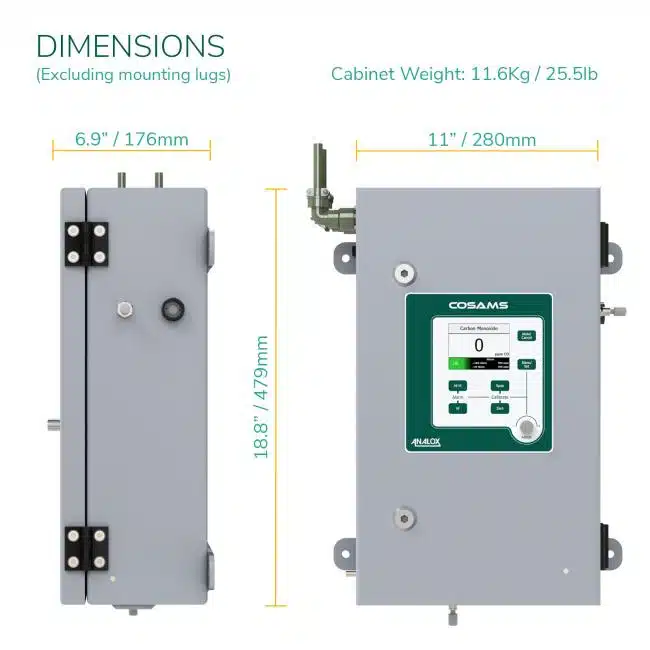
| Nominal cabinet dimensions (exc mounting lugs) | 479 x 280 x 176 mm (h x w x d) |
| Nominal cabinet dimensions (inc mounting lugs) | 479 x 360 x 200 mm (h x w x d) |
| Cabinet weight | 11.6 kg |
| Cabinet material | Aluminium |
| COSAMS Electrical | |
| Electrical supply | 115 V AC 60 Hz |
| Max power consumption | 90W |
| Fuse rating | (F1, F2): 20 mm, 2.5A anti-surge |
| Signal output | 4-20 mA |
| EMC compliance | MIL-STD-461F |
| ESD compliance | EN 61000-4-2 |
| COSAMS Performance | |
| Operating temperature range | 0 to +45°C |
| Storage temperature | 40 to +70°C |
| Operating pressure range | 800 to 1400 hPa |
| Extended pressure range | 600 to 800 hPa (Degraded performance over this pressure range) |
| Storage/transport pressure range | 300 to 1400 hPa |
| Operating humidity range | 0 to 80 %RH |
| Extended humidity range (up to 1 hour) | 80 to 100 %RH |
| Storage humidity range | 0 to 80 %RH (temporary max. 100 %RH) |
| Max. roll angle | 15° (constant), 45° (temporary) |
| Max. pitch angle | 10° (constant), 30° (temporary) |
| Shock | Tested at 22g, 20ms (half sine) without shock isolation |
| Vibration | NATO STANAG 4138 |
| COSAMS Environmental | |
| CO measuring range | 0 to 200 ppm |
| Repeatability, measured at RTP | ± (1 ppm CO + 1 display count) |
| Accuracy across normal operating environmental envelope | ±5% full scale (equivalent to ± 10 ppm) |
| Zero drift | ±1 ppm CO/day |
| Cross-sensitivity to hydrogen | 2% vol H2 < 1 ppm CO |
| Cross-sensitivity to CO2 | 5% vol CO2 < 1 ppm CO |
| Response time | T90 <60s |
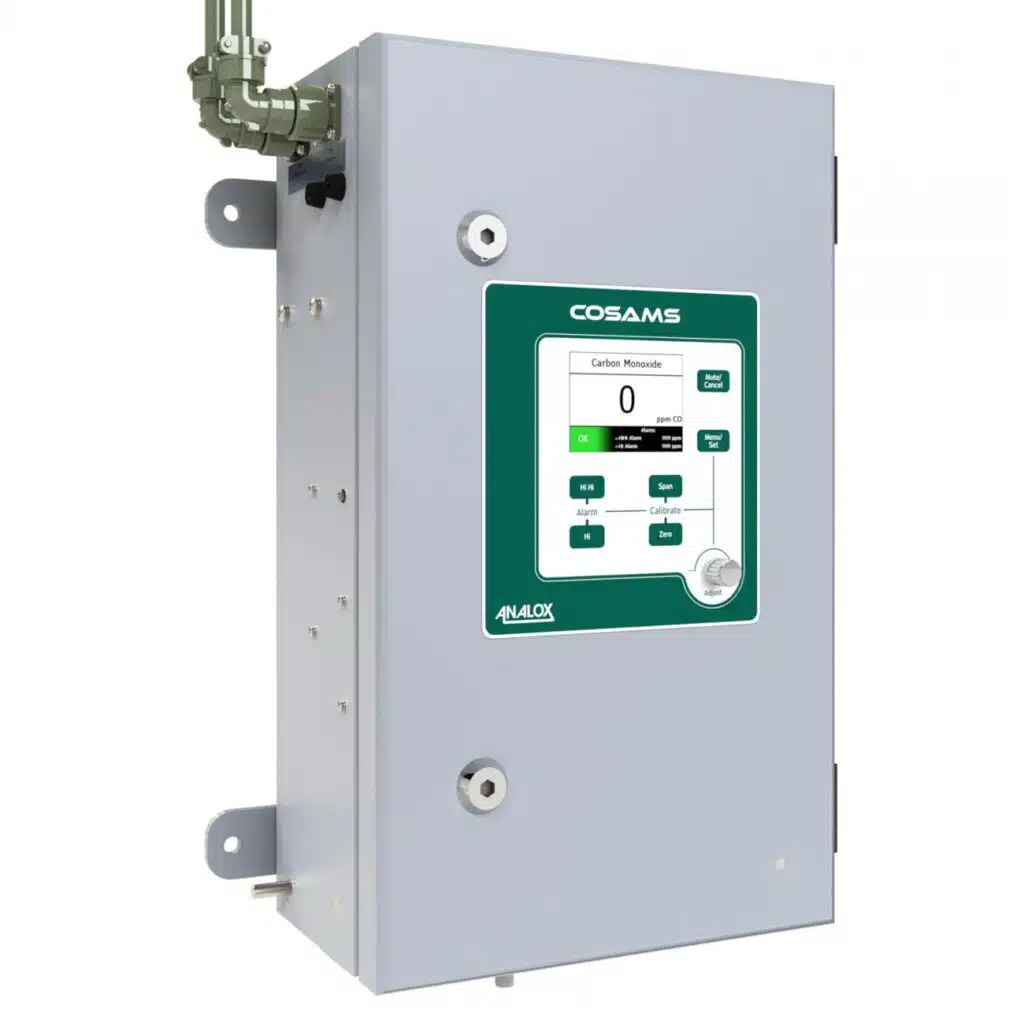
The COSAMS unit was designed specifically for use on submarines, most directly those that operate on diesel engines. Built to exacting military standards for performance, reliability and endurance, the Analox COSAMS uses proprietary Gas Filter Correlation (GFC) technology to specifically analyze the unique properties of CO.
The COSAMS (Carbon Monoxide Submarine Atmosphere Monitoring System) has been designed for use on submerged submarines to support life, where crew can be living and working for up to 90 days. Carbon monoxide can be generated on a submarine in several ways, from cooking and fire, to the incomplete combustion of diesel fuel and chlorate candles. 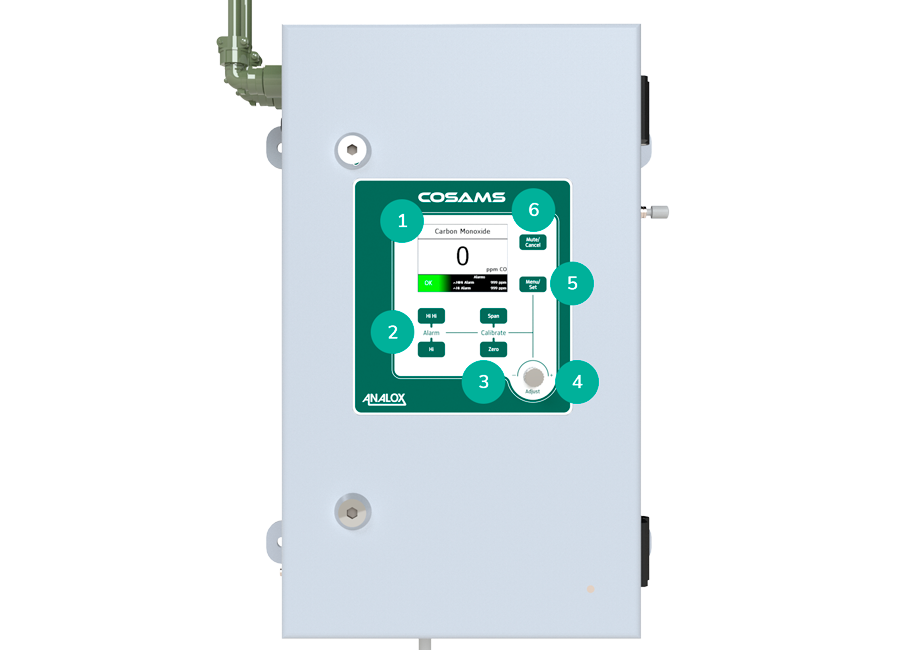
1. LCD
2. Alarm set point controls
3. Calibration controls
4. Rotary encoder
5. Menu/Set pushbutton
6. Mute/Cancel pushbutton
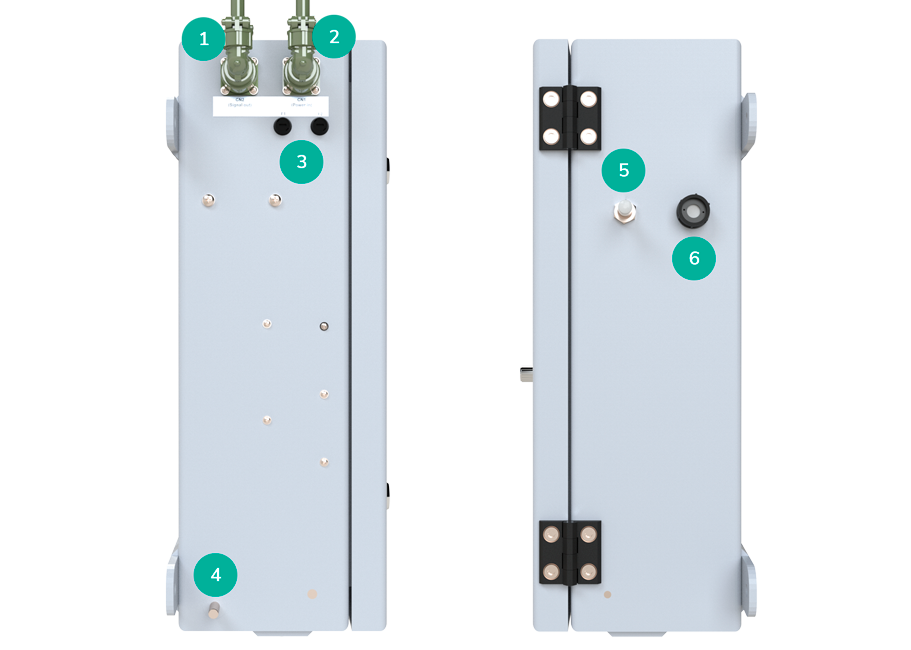
1. Power input
2. 4-20mA signal output
3. Two waterproof fuse holders
4. Earth stud for equipotential bonding to the submarine hull
5. Exhaust for gas sample
6. Water-proof breather port 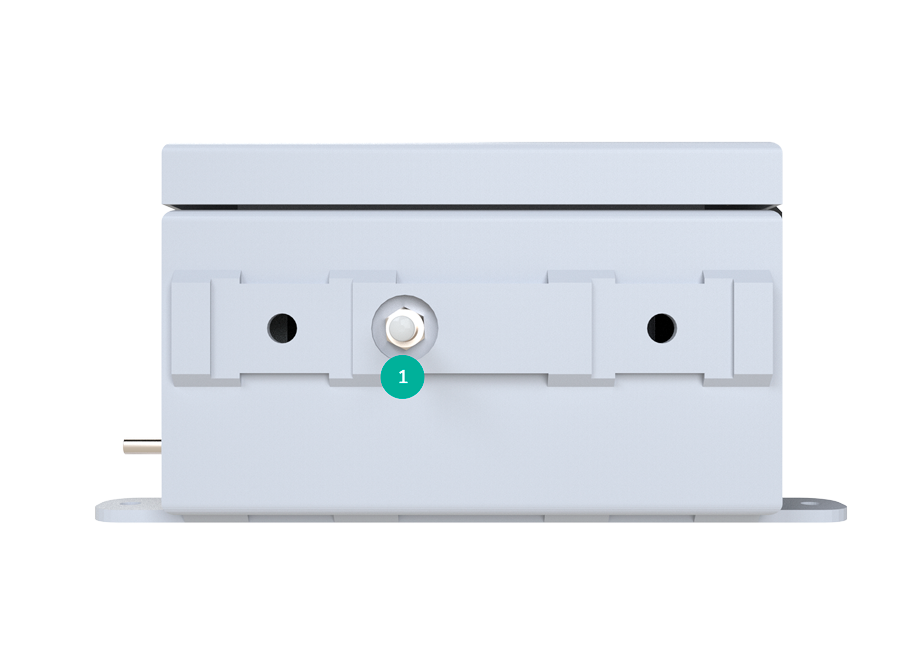
1. Gas inlet
Carbon monoxide can be generated aboard a submarine from both routine and emergency operations such as cooking, exhaust from diesel engines, the use of chlorate candles or even an onboard fire incident. In such an enclosed environment as a submarine, it is vital for the safety of all submariners onboard that accurate and continual monitoring of CO takes place. Anything else can result in deadly consequences.
The GFC sensor targets the exact wavelength of carbon monoxide and when the gas is detected, the sensor sounds an alarm. Because the sensor is seeking a unique wavelength, potential for cross-sensitivity from other gases or water vapor is eliminated. The monitoring is done continuously in real-time using the unique GFC infrared sensor to provide constant protection should CO contamination occur. The COSAMS will also NOT register any ‘false positives’ or inadvertent alarms.
In 2003, a Chinese submarine was discovered drifting in the Bohai Sea. It is speculated that all 70 crew members perished due to carbon monoxide poisoning caused by diesel engine exhaust. That is just one example of what can happen without proper monitoring aboard submarine fleets.
Modern submarines require continuous, highly reliable CO detection, but standard electrochemical sensors can give false readings due to cross-sensitivity—especially from hydrogen produced by onboard batteries. To solve this submarine-specific challenge, Analox developed COSAMS (Carbon Monoxide Submarine Atmosphere Monitoring System), a highly precise device designed to deliver accurate CO monitoring and enhance crew safety in demanding underwater environments.
The COSAMS unit offers continuous real-time monitoring CO. Two COSAMS units should be fitted in a submarine, one mounted to the fore, in the accommodation area, and the other aft, in the engine room. Each COSAMS indicates the local CO concentration on a color LCD and transmits a corresponding 4-20mA signal to the submarine’s Central Air Monitoring System. The COSAMS user interface permits calibration of the sensor and may be used to provide a local visual alarm, if desired.
The submarine environment poses a number of problems to standard off the shelf CO sensors. The common electrochemical cell is extremely cross sensitive to hydrogen, making it unsuitable for use in a submarine environment, where hydrogen is constantly produced during charging of the submarine batteries, thus providing a constant background level. Most toxic gas electrochemical cells also
suffer the added limitation of being very sensitive to changes in pressure. When you add the operating environment into the equation, you need equipment that can operate across a range of temperatures and humidity levels as well as through pressure changes.
Analox understands the technology challenges associated with using IR sensing techniques over dynamic pressure ranges and are able to correct for these effects to produce accurate sensors. The COSAMS unit uses an infra-red sensor which uses a gas correlation filter to minimize cross sensitivity to interfering gases in the environment.
The COSAMS unit consists of a single enclosure which contains all sensors, pneumatic fittings and display components. The user interface and display are presented on the front face of the enclosure. The enclosure is intended to be wall mounted using suitable shock-proof mounts. A gas sample is drawn from the submarine atmosphere around the enclosure, using the internal sample pump. The gas sample is analyzed before being exhausted to the atmosphere.
The unit offers two adjustable audio and visual alarms, a 4 to 20mA output and up to 90 day’s continuous data logging. Maintenance and calibration is designed to be carried out on board and in the dockyard.
| Weight | 11.6 lbs |
|---|---|
| Dimensions | 176 × 280 × 479 in |
Review the products in your quote list.
Send the request and our team will get back to you.
Thank you. Your quote request has been sent and our team will contact you soon.
Reviews
There are no reviews yet.